
The Petition for Separation and Indigenous Rights
Summary
The Crown is a party to a series of treaties with Indigenous peoples signed before Alberta was created as a province. The boundaries of individual treaties extend beyond what were later to become provincial and territorial boundaries.
Treaty rights are affirmed in s. 35 of the Canadian Constitution.
The Crown has a duty to consult with Indigenous peoples when it is aware of Indigenous rights and contemplates acting in a way that might adversely affect those rights. At a minimum, the consultation must be in good faith and with the intention of substantially addressing the concerns of Indigenous peoples whose lands are at issue.
The legislation in place when the application was made for the first separatist petition required that a petition proposal must not contravene Charter or constitutionally protected Indigenous rights.
On December 5, 2025, Justice Feasby ruled that the separatist proposal contravened both Charter rights and constitutionally protected treaty rights.
The legislation was amended to delete the requirement that a petition proposal must not contravene Charter or constitutionally protected treaty rights. A second application for a separatist proposal was approved by the Chief Electoral Officer.
On May 14, 2026, Justice Leonard ruled that the Crown had a duty to consult with Indigenous peoples before the Chief Electoral Officer approved an application for a petition. She quashed the approval of the separatist petition. That decision is now under appeal.
Background
In the late 1800s and early 1900s, the Crown as represented by the Government of Canada entered into a series of treaties with Indigenous peoples in Western Canada covering all the land in what later was to become Alberta and Saskatchewan, land that later became part of Manitoba, and land forming parts of British Columbia and the Northwest Territories. The boundaries of the lands covered by individual treaties extended across what were later to become provincial and territorial boundaries.
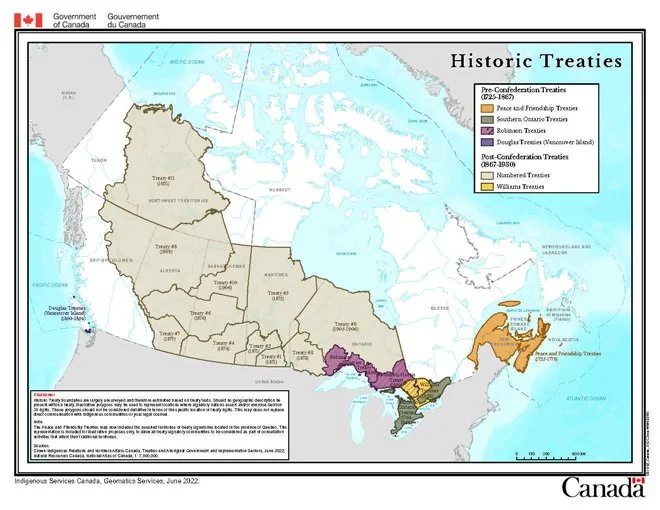
A map of Historic Indigenous Treaties in Canada.
Under each treaty, Indigenous peoples surrendered to Canada all of their rights, titles, and privileges to the land covered by the treaty. In exchange, the Crown made a number of promises, including the creation of reserves for the benefit of Indigenous peoples, the obligation to maintain schools on those reserves, and the recognition of the right of Indigenous peoples to pursue hunting and fishing throughout the lands they had surrendered.
In 1982, the Canadian Constitution was amended to create the Charter of Rights and Freedoms and to recognize the rights of Indigenous peoples under these treaties. Section 35(1) of the Constitution Act, 1982 provides:
The existing aboriginal and treaty rights of the aboriginal peoples of Canada are hereby recognized and affirmed.
This process was described by the Supreme Court of Canada in its 2004 decision in Haida Nation v. British Columbia in the following terms:
Put simply, Canada’s Aboriginal peoples were here when Europeans came, and were never conquered. Many bands reconciled their claims with the sovereignty of the Crown through negotiated treaties. … The potential rights embedded in these claims are protected by s. 35 of the Constitution Act, 1982. The honour of the Crown requires that these rights be determined, recognized and respected. This, in turn, requires the Crown, acting honourably, to participate in the processes of negotiation. While this process continues, the honour of the Crown may require it to consult and, where indicated, accommodate Aboriginal interests.
The Supreme Court of Canada has determined that the duty to consult arises when the Crown has knowledge, real or constructive, of the potential existence of the Indigenous right or title and contemplates conduct that might adversely affect it. The nature and scope of the duty of consultation varies with the circumstances but at a minimum the consultation must be in good faith and with the intention of substantially addressing the concerns of Indigenous peoples whose lands are at issue.
Analysis
When Mitch Sylvestre applied for a petition for separation of Alberta from Canada in July 2025, the Citizen Initiative Act prohibited a petition if the effect of the proposal would contravene either the Charter or rights protected under s. 35 of the Constitution Act, 1982. Under amendments to the Citizen Initiative Act that came into effect days before Mitch Sylvestre applied for his petition, the Chief Electoral Officer was empowered to ask the opinion of the Court of King’s Bench on whether a policy proposal contravened either the Charter or s. 35 of the Constitution Act, 1982.
Within days after the Sylvestre application was filed, the Chief Electoral Officer applied to the Court for an opinion on whether the proposal in that application contravened the Charter or s. 35. Submissions were made on this issue to the Court by Sylvestre, the Province of Alberta, and several First Nations.
On December 4, 2025, the Alberta government introduced Bill 14. Included within the provisions of that Bill, the prohibition on petitions that contravened rights under the Charter or s. 35 was to be eliminated, as was the power of the Chief Electoral Officer to ask the opinion of the Court of King’s Bench about compliance. Existing litigation on this issue was to be discontinued. Instead, the Alberta government was to be relieved of its obligation to implement a proposal for separation following a successful petition and a successful referendum if the proposal would contravene the Charter or s. 35. Instead of having the Chief Electoral Officer and the court deal with the issue upfront, the government would wait out the time, expense, and political and economic consequences of a successful petition and a successful referendum on separation before deciding whether or not to pursue separation because it conflicts with constitutional rights.
The following day, before Bill 14 was passed into law, Justice Feasby issued his opinion. (See our post: What did Justice Feasby decide?) He found that:
Alberta independence would contravene the treaties covering Alberta both as a matter of law and as a practical matter by removing Canada and substituting an independent Alberta as the entity responsible for fulfilling treaty obligations.
Alberta independence would transform provincial and territorial boundaries falling within the lands of specific treaties into international borders. That would contravene the treaties by significantly impairing the exercise of treaty rights by First Nations, such as the right to move freely within treaty lands for the purpose of hunting and fishing.
Justice Feasby also found that Alberta independence would contravene Charter rights because independence would require the replacement of the Canadian constitution without an assurance that Charter rights would be guaranteed in a new Alberta constitution. He also found that Alberta independence would contravene the Charter-guaranteed right to vote, mobility rights, and minority language rights.
As the proposal set forth in the petition contravened both Charter rights and constitutionally protected treaty rights, the petition was prohibited by the terms of the Citizen Initiative Act then in place.
Justice Feasby also found that the attempt by the Alberta government to prevent him from rendering his decision by discontinuing the case before him, contravened the rule of law and disrespected the administration of justice.
This decision was issued on December 5, 2025. Three days later, the Chief Electoral Officer rejected the first Sylvestre application for a petition on the basis that it was prohibited by the terms of the Citizen Initiative Act then in place because it contravened Charter rights and treaty rights recognized under s. 35 of the Constitution. Another three days later, Bill 14 came into force. The following day, Mitch Sylvestre applied again for a petition on separation under the amended legislation that no longer expressly prohibited petitions that would breach Charter rights or constitutionally protected treaty rights. Eleven days later, the Chief Electoral Officer approved this application and on January 2, 2026, he issued the petition.
An application was then brought by the Athabasca Chipewyan First Nation, Piikani First Nation, Siksika Nation, and Blood Tribe to quash the decision of the Chief Electoral Officer to issue this petition. On April 10, 2026, Justice Leonard granted a stay of the Chief Electoral Officer’s decision to issue the petition, pending release of her ruling on the merits. On May 13, 2026, she issued that ruling, quashing the decision of the Chief Electoral Officer to issue the petition.
The primary ground for Justice Leonard’s decision wasn’t related to treaty rights. Rather, it was based on an interpretation of the transitional provisions of Bill 14 and her finding that as Mitch Sylvestre’s first application for a petition had already been rejected by the Chief Electoral Officer, he couldn’t apply again for a petition on substantially the same terms.
Justice Leonard found as an additional ground that the Crown (in this case the government of Alberta) had a duty to consult with Indigenous peoples before putting in place a process that could lead to Alberta’s independence.
Justice Leonard applied the test in the Haida Nation case of the Crown’s real or constructive knowledge of an Indigenous or treaty right, contemplated Crown conduct, and potential adverse effects on the right arising from the Crown conduct. She found that Alberta was aware of the treaty rights and the potential impact a petition on separation, approved by an officer of the legislature, on those treaty rights, as determined by Justice Feasby. In these circumstances, she found that the action of the Chief Electoral Officer in approving the petition constituted Crown conduct for the purpose of triggering the duty to consult. Because no consultation occurred, the government of Alberta breached its duty to consult.
Justice Leonard also explained why the harm was not too remote: although the Referendum Act says that a successful result need not be implemented if it would breach s. 35, that safeguard comes too late, because once a referendum on separation succeeds, the matter passes into the political realm and beyond the court’s supervision.
Justice Leonard found as a further additional ground that the decision by the Chief Electoral Officer to issue a petition calling for Alberta independence was unreasonable in the face of the finding by Justice Feasby that such a petition would contravene s. 35 of the Constitution Act, 1982, because the Chief Electoral Officer is bound to exercise authority in a manner that complies with the constitution.
In the result, the route to success of a petition for a referendum on separation of Alberta from Canada was blocked. While both the government of Alberta and the petitioner stated that they intended to appeal Justice Leonard’s decision, there was no realistic chance that this decision could be successfully appealed in time to allow a campaign on separatism in advance of October 19.
The route to a referendum on separation through the Referendum Act was blocked as well. This legislation gives the government broad authority to put questions to a referendum (as it had already done with the other 9 questions scheduled for the October 19 vote.) But if prior consultation by the government with Indigenous peoples was required before the Chief Electoral Officer could approve a petition on separation that might lead to a referendum proposing separation, prior consultation by the government was also required before it could act directly to call a referendum proposing separation under the Referendum Act.
For a description of how the government came to call a double-barrelled referendum question to either stay in Canada or start the process of consultation:
See our post: What happened to the Forever Canadian petition?