

‘Underneath the careful wording of Alberta’s referendum question on separation is a much larger question: to be, or not to be, Canadian. That is the question.’
With those words, the Canada West Foundation introduces its special report on a range of topics related to Alberta’s October 19 referendum on separation. Titled Alberta in Confederation – The Economic, Trade and Constitutional Realities of Separation, the report includes papers and analysis by nine authors covering a range of topics from Alberta’s place in confederation, constitutional implications of separation, Indigenous rights and treaty relationships, Alberta’s economic and fiscal position, trade policies and interprovincial and international transportation, and the impact of uncertainty on investors’ decisions.
Drawing on comparisons with Brexit in the UK and Quebec’s experience with its own separation vote, the report highlights the lesson we should take from both of those experiences. In their words, “The lesson is not that Alberta should reach the same conclusion as voters elsewhere. It is that voters deserve to understand the risks and consequences before making a decision that may be difficult, costly or impossible to reverse.” At Before You Vote, we heartily agree.
The significance of Alberta’s vote on October 19 is highlighted in the introduction to the report by Gary Mar, President and CEO of the Canada West Foundation.
“Albertans deserve to understand the grievances that have brought us to this point. They also deserve to understand the opportunities, responsibilities, risks and uncertainties that would follow from any change in Alberta’s constitutional status.
Most of all, they deserve to make their decision with their eyes open, knowing what we know, recognizing what can reasonably be estimated, acknowledging what remains uncertain and understanding what would still have to be negotiated.
The question before Albertans is consequential for more than one generation. It concerns the country their parents and grandparents helped build, the province they have inherited and the future they leave to their children.”
You can find the full special report from the Canada West Foundation here, and we encourage you to read it.
Opinion: Immigration questions in fall referendum a measure of who we are as Albertans
Originally published at CalgaryHerald.com on September 5, 2026.
On October 19th Albertans will be invited to express their opinions through a referendum that, in a convoluted manner, asks us whether Alberta should begin a process to separate from Canada.
We are also being asked a series of disturbing immigration related questions. These questions are likely unconstitutional and designed to satisfy the extremist element of the United Conservative Party (UCP).
One might ask why, as a province, we are spending an estimated $150 million dollars and requiring 60,000 employees to ask us these referendum questions when this money could be put to much better use responding to the growing pressures in our education and health care systems? But here we are. Referendums are a waste of time and energy, voter turnout is poor and their results do not reflect public opinion.
Very little discussion and exposure centers around the ambiguous and unconstitutional questions surrounding immigration. In fact, many Albertans are not even aware there are questions other than the separation question. It is time for Albertans to focus on the negative implications that are contained in the immigration enquiries.
As we think about who we are as Canadians and as Albertans, the message we send with our responses to the racist immigration questions may say more about us than anything else. We need to pay close attention to the implications of the immigration questions being put forward. We need to reject all of them and vote NO.
The referendum proposes increased provincial control over immigration, restrictions on access to services for non-permanent residents, a “head tax” discriminatory fee system for non-permanent residents, a 12-month waiting period for social supports, fees for healthcare and education, and citizenship verification for voting. These changes will significantly impact non-permanent residents (some 65,000 people) which includes temporary foreign workers, international students, and refugee claimants.
The implication seems to be that these newcomers fill our hospitals and schools and take jobs away from Albertans. To scapegoat our newcomers as the source of funding pressures in our schools and hospitals passes the buck to others over our failure to meet the demands created by our growth and prosperity.
The flawed premise of these questions rests on the assumption that this group of newcomers to Alberta are taking advantage. It is alleged that they don’t contribute, they cost us money and therefore they should be prevented from accessing services and should be back of the line for employment opportunities. Not only are these assumptions discriminatory, they are factually inaccurate. These individuals pay taxes for starters, but more importantly the assumptions ignore the many and necessary contributions newcomers make to our province and our country. They ignore the fact that immigration is the foundation of growth and prosperity in our province and perhaps most importantly, they ignore the pride we have always taken in being a welcoming country and province where difference is a strength. Other than indigenous and first nations peoples, we can all trace our histories to other shores.
We already have many children in Alberta being denied entrance to our schools because their parents lack immigration status. Are we becoming so insular that we can stand aside and allow children living in our Province to be denied education and health care?
There is no denying that we need new Canadians to fill the gaps created by smaller families and an aging population. These social trends will have a negative impact in the future where fewer workers will be available to meet the expanding needs of the province.
It is incumbent upon the Provincial and Federal governments to work together to create and implement programs that will recognize the population growth needs in our society. This is not a task for provinces alone. This is a national challenge and well outside exclusive provincial jurisdiction.
Unfortunately, our current provincial government has not demonstrated any ability to address these types of issues with the intelligence, humanity and compassion they demand. For all of these reasons, it is important that we vote to stay in Canada and vote no to all nine of the divisive questions manufactured by the provincial government. In particular, we must remember who we are as Albertans and Canadians and reject the false and racist premises upon which the referendum immigration questions are based.
Ron Ghitter (KC, CM – Member of Order of Canada), is a former Alberta MLA and senator and founder of the Dignity Forum. Cori Ghitter (KC) is the CEO of the Ron and Myrna Ghitter Foundation and a member of the Dignity Forum.
Understanding the Immigration Questions
Our immigration system is not perfect. The rapid increase in immigration in the decade leading up to 2024 without building out the infrastructure necessary to accommodate that immigration created challenges for the Canadian economy. While steps have now been taken to reduce the level of immigration to more sustainable levels, it is reasonable to consider other steps that might be taken to reform and improve the system.
In its October 19 referendum, the Alberta government has posed 5 questions relating to immigration. In our view, the proposals put forward in those questions would not improve the system. Rather:
they would create barriers to mobility in Canada, undermining efforts to strengthen the economy in the face of US tariffs,
they would exclude some persons lawfully resident in Alberta from accessing basic services, like education and health, contrary to fundamental Canadian values, and
they would create a barrier to voting by some particularly vulnerable Canadian citizens resident in Alberta.
Creating barriers to mobility within Canada
Question 1: Do you support the Government of Alberta taking increased control over immigration for the purpose of decreasing immimgration to more sustainable levels, prioritizing economic migration and giving Albertans first priority on new employment opportunities?
This is a complicated question, best understood by considering its constituent parts.
The first part involves the Alberta government taking increased control over immigration. As discussed in more detail in our article Question 1: A Poor Question offering Vague Choices, the Alberta government already has significant influence over economic immigration, including through the Alberta Advantage Immigration Program. It should be noted that Question 1 does not propose any change in the constitutional distribution of authority over immigration; it only contemplates the Alberta government exercising the constitutional authority that it already has. A costly referendum isn’t necessary for a government to continue to do what it is already doing.
The second part of the question involves decreasing immigration to more sustainable levels. As noted above, steps have already been taken to reduce the level of immigration in Canada. As stated by Immigration, Refugees and Citizenship Canada, its 2026-2028 Immigration Levels Plan “focuses on a return to sustainable immigration levels through continued decreases to temporary resident arrivals and stabilized permanent resident admissions.” The decrease in the number of immigrants entering Canada actually resulted in a decrease in the population of Canada in 2025, the first time that has happened since Confederation. And the Alberta Economic Dashboard shows a change in net international migration to the province between the first quarter of 2025 and the first quarter of 2026 of minus 105.8%. It isn’t clear what steps, if any, the Alberta government proposes to further decrease the number of immigrants coming to Alberta.
The third part of the question involves prioritizing economic immigration. Canada already prioritizes economic immigration. Under the 2026-2028 Immigration Levels Plan, permanent economic immigration is forecast to reach 63% of all permanent admissions in 2026, rising to 64% in 2027 and 2028. It isn’t clear what steps, if any, the Alberta government proposes to further prioritize economic immigration.
The fourth part of the question involves giving priority to Albertans on new employment opportunities. The temporary foreign workers program already gives priority to Canadian workers; it permits immigration to fill temporary labor shortages when qualified Canadians or permanent residents are not available. The proposal in Question 1 goes further than this by using the immigration system to give priority to Albertans, not Canadians. It isn’t at all clear how this would work. However, if Alberta could somehow use the immigration system to give priority for new employment opportunities to Albertans to the exclusion of other Canadians, other provinces could do the same to the exclusion of Albertans, thereby undermining mobility within Canada.
Quite apart from raising issues under the Charter of Rights and Freedoms, this proposal would involve erecting internal barriers at the very time that Canada and the provinces have committed to removing internal barriers to strengthen the Canadian economy in the face of the trade war with the United States.
Taking Question 1 as a whole, it is unclear what the Alberta government is proposing beyond what is already being done. What is new appears to be a proposal that would create mobility barriers within Canada.
For these reasons, we are voting NO to question 1.
Excluding some immigrants from access to education, health and other services
Question 2: Do you support the Government of Alberta introducing a law mandating that only Canadian citizens, permanent residents and individuals with an Alberta-approved immigration status will be eligible for provincially-funded programs, such as health care, education and other social services?
Question 3: Assuming that all Canadian citizens and permanent residents continue to quality for social support programs as they do now, do you support the Government of Alberta introducting a law requiring individuals with a non-permenant resident legal immigration status to residen in Alberta for at least 12 months before qualifying for any provincial-funded social support programs?
Question 4: Assuming that all Canadian citizens and permnanent residents continue to qualify for public health care and education as they do now, do you support the Government of Alberta charging a reasonable fee or premium to individuals with non-permanent resident immigration status living in Alberta for their and their family’s use of the health care and education systems?
All three of these questions propose excluding some groups of immigrants from access to publicly-funded education and health services. Questions 3 and 4 go further to exclude persons from access to other publicly-funded services. While the category of excluded persons under Question 2 is unclear as “Alberta-approved immigration status” is undefined, all 3 questions likely apply to exclude temporary foreign workers, refugees, and foreign students from publicly-funded services.
Question 2 proposes a permanent exclusion, at least until an individual becomes a permanent resident of Canada. Question 3 proposes an exclusion for one year after an individual moves to Alberta, no matter how long that individual has lived in Canada. Question 4 proposes that services be available only if a “reasonable fee or premium” is paid. Those who can’t afford to pay the fee or premium (in other words, those who are poorest) would be excluded from accessing the services.
To put this in practical terms, these proposals would mean that the eight-year-old child of a temporary foreign worker could be excluded from accessing public education. These proposals would mean that a 70-year-old refugee from Ukraine who is suffering a stroke could be excluded from accessing public health care. These exclusions would apply notwithstanding the fact that the excluded persons were legally admitted to Canada and pay federal and provincial taxes, just like everyone else.
The fundamental objection to these proposals was articulated by Senator Paula Simons in an article recently published in Alberta Views magazine:
“On what planet does it make any sense to prevent refugee and immigrant children from going to school, learning English and integrating? Let’s leave empathy and humanity aside for a moment. Does it make our communities safer or more prosperous to prevent children—including those whose parents are here legally—from acquiring the language skills, academic training and cultural know-how to work and thrive and contribute to our economy and society?”
The same objection applies to exclusion from health care and other publicly funded services. Once an individual has been legally admitted to Canada, that individual should not be denied access to basic social services. Exclusion from access is a denial of individual human rights. It is also detrimental to the growth and strengthening of our society.
On its referendum website, the Alberta government provides three arguments in support of the proposed exclusions.
The first is that the cost of delivering these services to these persons is estimated to cost Alberta taxpayers more than $1 billion per year. No authority is cited for that number. Nor does the website state the amount of taxes paid each year by these persons.
In any event, even if costs incurred exceed taxes paid by these persons, the right of an individual to access basic services in our province has never been based on whether the taxes paid by that individual exceed the cost of services accessed by that individual. In other words, access to services has never been based on whether an individual is a profit centre for the province. That isn’t who we are as a society. Indeed, those that most need publicly-funded services, like the elderly or persons with disabilities, are often those with the least income, and therefore those paying the least taxes. Accepting the argument that access to publicly-funded services by an individual should be based on a comparison of costs incurred versus taxes paid would set a very dangerous precedent for all Albertans.
The second argument made by the Alberta government is that past immigration policies have led to rapid population growth in the province, which has put “pressure on Alberta’s health, education and other social services, resulting in delayed access to health care for Albertans, larger classrooms for students and unaffordable cost pressures to social services overall.”
What this argument does not mention is that the rapid growth of Alberta’s population arose from both internal migration and immigration and was the result of the conscious policy of the Alberta government. On a podcast in January 2024, Premier Danielle Smith expressed the goal of more than doubling the population of Alberta to 10 million people, using internal migration and immigration. In pursuit of population growth, the government introduced the Alberta is Calling campaign to encourage people from across the country to move to Alberta. And in March 2024, the Premier sent a letter to the Prime Minister, requesting the federal government to double the allocation of places for immigrants to Alberta under the Provincial Nominee Program and under the Ukrainian refugee program.
The cause of the strain on government services is the implementation of the policy to pursue rapid population growth without investing in the infrastructure necessary to support that growth. One example of that failure is the strain on hospitals in Alberta. In Edmonton for example, the population of the city has doubled since 1988 when the last new hospital was constructed.
The problem isn’t limited to physical infrastructure. It also extends to failure over the years to invest in additional spaces for training professionals, like doctors and nurses, needed to meet the growth in population promoted by the province. In 2023, we saw a hopeful sign with the announcement of provincial funding for additional seats in medical and nursing schools and for additional medical residency places. Given the time required to complete this training, the impact of that additional funding has yet to be felt.
At best, it is disingenuous to blame the strain on schools, hospitals, and other facilities on temporary foreign workers, refugees, and foreign students. And the solution to that strain is to build the infrastructure needed to support the population, not to exclude categories of immigrants from accessing publicly-funded services.
The third argument made by the Alberta government is that youth unemployment in Alberta is high (at 15.6%), suggesting temporary foreign workers are taking the jobs of young Albertans. No evidence is cited in support of this suggestion. In a report issued in July 2026, the Canadian Federation of Independent Businesses disputes the alleged link between youth unemployment and the hiring of temporary foreign workers, arguing that “the jobs most commonly filled by Temporary Foreign Workers are exactly the ones that young Canadians are least willing to take.”
In any event, even if the Alberta government could establish some link between youth employment and hiring temporary foreign workers, the solution to youth unemployment is not to deny access to health, education, and other publicly-funded services to temporary foreign workers, refugees, and foreign students legally admitted to this province.
For these reasons, we are voting NO on questions 2, 3, and 4.
Creating a barrier to voting by vulnerable Albertans
Question 5: Do you support the Government of Alberta introducing a law requiring individuals to provide proof of citizenship, such as a passport, birth certificate or citizenship card, to vote in an Alberta election?
This question isn’t whether the right to vote should be limited to Canadian citizens. That is already the law. Rather, the question is whether individuals should be required to provide proof of citizenship before being allowed to vote. And as only Canadian citizens are allowed to vote, the question is whether Canadian citizens should be required to provide proof of their citizenship before being allowed to vote.
The rationale for this question, presumably, is to avoid non-citizens from voting by pretending they are citizens. There is no evidence that this a problem.
In fact, this question comes directly from the MAGA playbook. President Trump has announced that his first legislative priority is the passing of the so-called SAVE America Act, which would require proof of citizenship to vote in federal elections. This piece of legislation has been passed by the House of Representatives but has been blocked in the Senate. In August 2026, President Trump unsuccessfully demanded that the Senate’s August break be cancelled until it passed this Act. He also unsuccessfully demanded that the filibuster power in the Senate be terminated in order to pass this Act. This legislation is strongly opposed by civil rights groups across the country.
In the United States, as in Canada, there is no evidence of wide-spread voter fraud by non-citizens. A requirement to produce proof of citizenship is a solution in search of a problem. And it is a solution with potentially serious side effects.
The objection to the requirement of proof of citizenship as a condition of voting is that it has the effect of disenfranchising some of the most vulnerable members of society.
One third of Canadian citizens do not have passports. To state the obvious, those without passports are those who are not travelling outside the country. And those who are not travelling outside the country, on average, are less affluent than those who are travelling outside the country. For more affluent Canadians holding passports, producing proof of citizenship isn’t particularly burdensome. For less affluent Canadians without passports, producing proof of citizenship is more challenging.
Question 5 proposes birth certificates or citizenship cards as alternatives to passports for proving citizenship for the purpose of voting. But not everyone has their birth certificate readily available. And obtaining a citizenship certificate (citizenship “cards” referred to in Question 5 are no longer issued) requires a birth certificate for those born in Canada and additional documentation for those born outside Canada.
Again, for some of the most vulnerable individuals in our society, including those who are unhoused, the requirement to produce this documentation may present a barrier to voting.
As there is no evidence of wide-spread fraud involving attempts to vote by persons who are not Canadian citizens, there is no justification for requiring Canadian citizens to produce documentation proving their citizenship as a condition of voting.
For this reason, we are voting NO on Question 5.
If you’re voting by mail, NO you don’t have to attest that you’re not able to vote in person.
Check out this article written by Cole Bennett on cole.notecole and the How To Vote section on our website for detailed instructions.
Opinion: Referendum questions are meant to divide Albertans
Originally published at EdmontonJournal.com on September 2, 2026.
On Oct. 19, Albertans are being asked to vote on 10 troubling referendum questions. We believe the five discriminatory and hateful questions targeting new Albertans deserve more attention, and we are united in calling out the divisive politics and poor leadership behind them.
The question of Alberta’s independence has sucked up most of the oxygen, but the other questions deserve scrutiny for what they reveal about the politics of the day. Rejecting them all, particularly the mean-spirited immigration questions, offers a chance to stand up for a welcoming Alberta within a stronger united Canada.
Four questions seek to treat some immigrants differently, limiting or withholding their access — or, appallingly, their children’s access — to education, health care and other social supports. These questions are framed as fiscal measures, as if human beings are nothing but the cost of the services they use. As elected leaders, we all took oaths to serve and respect everyone who lives here, even our guests.
That used to go without saying. By contrast, the thrust of these four questions would effectively create a caste system in Alberta. We reject that inhospitable worldview — that’s not the Alberta we know.
Another question asks whether folks should have to show proof of citizenship at the time they vote (regardless of whether they are already on the voters list). However, there is not one shred of evidence that anyone is voting illegally. This question is there simply to imply that some immigrants are voting improperly — which has troubling echoes of the American far right’s campaign in the 1960s to keep Black voters from casting ballots, and is making it needlessly harder for all of us to exercise our democratic rights.
(On this point, along with the cumbersome multi-ballot process that will likely create longx lines, we strongly recommend eligible voters request mail-in ballots for your own convenience, and to make space at the polls for others.)
Chris Sturwold: How I’m voting on Alberta’s ten referendum ballots — and why.
A Breakdown Guest Op-Ed by Chris Sturwold.
Alberta’s economy benefits by up to $200 billion over the next decade byremaining within a renewed Canada
That’s the key finding from new economic modelling by Alberta economist Lennie Kaplan.
The roughly 4% increase in growth in Alberta’s GDP stems primarily from increases in Alberta’s oil production to around 7.5 million barrels per day by 2035 – an increase that’s possible if Alberta chooses to remain in Canada. Kaplan points to key factors indicating that level of increase is possible: private sector investments in projects such as the West Coast Oil Pipeline, other announced pipeline expansions and optimizations, brownfield and greenfield oil sands projects, and the Pathways Carbon Capture and Storage project.
All those projects are more likely to proceed under what Kaplan calls a new economic deal with Canada. Conversely, he warns those projects would be in jeopardy due to the uncertainty and need for difficult negotiations with the US and others if Alberta chooses to separate.
Other key findings include:
Up to a $40 billion or 7% boost to Alberta’s GDP in 2035
Up to 120,000 or a 4% increase in Alberta jobs in 2035
Up to $250 billion or a 20% boost to cumulative investment over the next decade
Up to $8 billion or a 10% boost in provincial government revenues in 2035
Up to $45 billion or a 5% boost in cumulative provincial government revenues over the next decade
Aside from benefits to Alberta, Kaplan concludes that “pursuing a new economic deal between Alberta and Canada, rather than independence, will benefit all Canadians, and give our country greater leverage in difficult negotiations with the United States over a renewed Canada US Mexico trade agreement (CUSMA).”
Jared Wesley: Decoding the Separatist Playbook
Albertans should learn to recognize these tropes in the coming months
Are reports of foreign influence in separatism vote true? Research suggests they are.
In an August 17, 2026 article in the Globe and Mail (Russian, U.S. interests are targeting Alberta’s separatist debate Canadian research shows) journalist Grant Robertson reports that Canadian researchers are tracking foreign influence in Alberta's separatism debate using an AI tool called Cipher. This AI tool was developed by Brian McQuinn at the University of Regina's Centre for Artificial Intelligence, Data, and Conflict, in partnership with the University of Alberta.
Robertson reports that Cipher was originally built to monitor Russian disinformation about the invasion of Ukraine. Early this year, researchers noticed the same Russian networks shifting focus to Alberta. They recalibrated the tool to track this new target ahead of October's referendum.
Cipher tracks online accounts and platforms that publish, distribute or amplify content from foreign sources related to Alberta. Robertson notes that according to Dr. Quinn, Alberta separatism is a predictable target for outside forces who want to undermine Canada, stoke anger, or influence the October referendum results.
Cipher reports covering the month mid-July to mid-August have found roughly 300 pieces of foreign-linked disinformation. About 80% traced back to Russian sources, and 20% to American ones.
The research found two distinct patterns of foreign involvement.
Russian activity is mostly covert. It's driven largely by the Pravda Network, a content farm that produces material that looks like real news but is designed to inflame divisions. This content spreads through Canadian social media when people share it knowingly or unknowingly. Much of it frames economic grievances, like tariffs and affordability, as proof Alberta is being punished by the rest of Canada.
American involvement is more open. Right-wing podcasters, websites, and MAGA-aligned influencers have publicly argued that Canada is a "failed state" that Alberta should leave, while separatist leaders openly meet with Trump administration officials.
Albertans need to wake up to reality
That’s the message from Lawrence Herman, an international lawyer and a senior fellow at the C. D. Howe Institute.
In an August 15, 2026 article in the Globe and Mail (“An independent Alberta would need to negotiate its trade and treaty relationships”) Herman notes that, under international law, newly formed countries don’t simply inherit pre-existing arrangements. “They have to negotiate their way in.”
That means all deals are off. Alberta would need to renegotiate all its existing trade and treaty relationships.
Yes, we have oil. And that gives us some leverage but perhaps not as much leverage as the separatist rhetoric would suggest, especially when it comes to confronting a huge, economically powerful, and currently unpredictable country like the U.S.
As Herman notes, “This brings us to the challenges Alberta would face in securing stable, beneficial access to the American market, something that, whatever other issues may be in play, would be the most critical factor for its future as an independent country. It’s in this respect that the people of Alberta need to wake up to reality.”
The outcomes of current trade negotiations with the U.S. are uncertain at best and whatever trade deal emerges, it will be a deal among the U.S., Canada and perhaps Mexico. Admitting a separate Alberta to that deal would require an agreement from all three countries. Alberta would not automatically be included.
In addition to the U.S., an independent Alberta would also not automatically get the rights and benefits it enjoys under Canada’s existing trade agreements with other countries and regions around the world. That includes current agreements with the European Union, the Asia-Pacific region, and the new Canada-South Korea free trade agreement.
And then there’s tariffs. Herman notes that no foreign country would automatically grant the same tariff concessions to Alberta exporters as the rest of Canada has. That means Alberta would face the prospect of lengthy negotiations with other countries just to get the same market access Alberta’s companies and industries currently have.
Herman concludes with this chilling observation: “No one denies that Alberta has leverage with its huge oil and gas reserves. This gives us some serious cards to play. But once out of Canada and playing those cards internationally will involve a long, convoluted and highly uncertain game. While all this is happening, who would buy Alberta bonds?”
Jared Wesley: Don't look away
“The racism on display at some separatist town halls is an important part of our provincial discussion.”
What are the referendum questions?
On October 19, Albertans will be asked to vote on ten referendum questions.
Immigration:
Albertans will mark yes or no to the following questions related to immigration.
Question 1
Do you support the Government of Alberta taking increased control over immigration for the purpose of decreasing immigration to more sustainable levels, prioritizing economic migration and giving Albertans first priority on new employment opportunities?
Question 2
Do you support the Government of Alberta introducing a law mandating that only Canadian citizens, permanent residents and individuals with an Alberta approved immigration status will be eligible for provincially-funded programs, such as health care, education and other social services?
Question 3
Assuming that all Canadian citizens and permanent residents continue to qualify for social support programs as they do now, do you support the Government of Alberta introducing a law requiring all individuals with a non-permanent legal immigration status to reside in Alberta for at least 12 months before qualifying for any provincially-funded social support programs?
Question 4
Assuming that all Canadian citizens and permanent residents continue to qualify for public health care and education as they do now, do you support the Government of Alberta charging a reasonable fee or premium to individuals with a non-permanent immigration status living in Alberta for their and their family’s use of the healthcare and education systems?
Question 5
Do you support the Government of Alberta introducing a law requiring individuals to provide proof of citizenship, such as a passport, birth certificate or citizenship card, to vote in an Alberta provincial election?
Constitutional changes:
Albertans will mark yes or no to the following questions.
Question 6
Do you support the Government of Alberta working with the governments of other willing provinces to amend the Canadian Constitution to have provincial governments, and not the federal government, select the justices appointed to provincial King’s Bench and Appeal courts?
Question 7
Do you support the Government of Alberta working with the governments of other willing provinces to amend the Canadian Constitution to abolish the unelected federal Senate?
Question 8
Do you support the Government of Alberta working with the governments of other willing provinces to amend the Canadian Constitution to allow provinces to opt out of federal programs that intrude on provincial jurisdiction such as health care, education, and social services, without a province losing any of the associated federal funding for use in its social programs?
Question 9
Do you support the Government of Alberta working with the governments of other willing provinces to amend the Canadian Constitution to better protect provincial rights from federal interference by giving a province’s laws dealing with provincial or shared areas of constitutional jurisdiction priority over federal laws when the province’s laws and federal laws conflict?
Separation:
Albertans will have the choice of two options and will mark an X beside the choice they prefer.
Question 10
Should Alberta remain a province of Canada, or should the Government of Alberta commence the legal process required under the Canadian Constitution to hold a binding provincial referendum on whether or not Alberta should separate from Canada?
Option 1
Alberta should remain a province of Canada.
Option 2
The Government of Alberta should commence the legal process required under the Canadian Constitution to hold a binding provincial referendum on whether or not Alberta should separate from Canada.
The Isolation Risk of a Separate Alberta
If Alberta separates from Canada, it risks becoming isolated — not isolated from the world in some literal sense but cut off from the political and economic systems that currently give it influence and reach far beyond its size.
This is, for now, a hypothetical scenario as Canada's constitution does not give a province a unilateral path to independence, and any actual separation would require negotiation involving the federal government, the other provinces, and First Nations, whose treaty and constitutional rights are directly implicated by any change to Alberta's status. But it's a hypothetical worth examining carefully, because it clarifies what is at stake in the broader debate.
To avoid the isolation that separation would risk, an independent Alberta would need to replace the diplomatic and economic architecture it is part of today: trade access, financial integration, institutional credibility, and a seat at the table in international affairs. The central risk is whether Alberta could replace what it would lose.
None of this is a judgment about Alberta's capability. Alberta has real strengths: abundant natural resources, a highly educated workforce, strong institutions, and a dynamic entrepreneurial culture. Alberta also has something few regions in the world possess: extensive control over its own affairs in a federal system, while operating inside a G7 country with a large integrated market, internationally respected institutions, established trade agreements, global diplomatic influence, secure borders, and transportation networks built over more than 150 years. Separation would mean stepping outside all of it and trying to rebuild as much of it as possible all at once.
Economic Isolation
One of Canada's greatest advantages is that its economic systems are so smooth they're almost invisible.
An Edmonton company can sell to customers in Toronto, Montreal, or Halifax without customs declarations, currency exchange, immigration restrictions, or separate regulatory systems. A worker from Calgary can move to Vancouver or Ottawa without a visa. A business can raise capital through Canadian financial markets under familiar rules and institutions. Migration from other provinces to Alberta has been critical to the growth of Alberta’s economy.
While regulatory differences between provinces sometimes create internal barriers, the federal government and the provinces have committed to bring down those barriers.
These advantages of economic integration are more than minor conveniences. They lower costs, encourage investment, and let businesses operate at a scale that smaller, fragmented markets cannot support. Economists have long recognized that market size matters: larger integrated markets create more room for specialization, innovation, and productivity growth, and businesses invest more readily when they can count on a predictable environment with millions of potential customers and established rules.
Brexit provides the clearest recent illustration and warning. The UK remains a wealthy advanced economy that continues to trade internationally, but reduced EU integration has brought new administrative costs, disrupted supply chains, and narrowed market access while Britain had decades of independent institutions to fall back on while renegotiating. Alberta would face the harder task of building that infrastructure for the first time while replacing what it had lost. Even under cooperative negotiations, the likely result is a less effective version of today's advantages, and not a full replacement.
Diplomatic Isolation
Independence offers a clear benefit: more control over domestic decisions. But sovereignty and influence aren't the same thing and gaining one doesn't automatically deliver the other.
International influence comes from economic scale, diplomatic networks, and institutional credibility, not legal status alone. Canada's weight comes partly from being a stable G7 country of forty million people with decades of established relationships. An independent Alberta would enter that world with roughly five million people. This is not a fatal weakness, since many smaller states prosper, but smaller countries typically compensate with careful diplomacy and alliances built over time, not overnight.
Trade negotiations between an independent Alberta and other countries would similarly reflect Alberta’s size and lack of institutional credibility, relationships, and history. Canada negotiates with a global network of embassies, decades of experience, and institutions other governments already trust. Alberta would need to build diplomatic representation, negotiating teams, and regulatory agencies largely from scratch. These could eventually become effective, but in the meantime, Alberta would start as an unfamiliar and inexperienced negotiating partner without the trust and respect Canada has earned over generations.
Geography can't be replaced
Some losses could theoretically be rebuilt, given time and money, but geography is different. It can only be managed, never replaced. Alberta is landlocked. Exporting oil, gas, agricultural products, and manufactured goods depends on transportation corridors to external markets. Railways, pipelines, and port access would all require agreements with neighbours. Switzerland and Austria show that landlocked countries can prosper, but only through extensive, permanent cooperation and an ongoing interdependency.
Today, Alberta benefits from a country that manages national transportation systems, protects access through other provinces and territories, and negotiates access with other countries as a matter of course. An independent Alberta would need to build its own version of those arrangements while depending indefinitely on its neighbours' goodwill and self-interest. While the United Nations Convention on the Law of the Sea provides an avenue for a landlocked country to negotiate access through another country, such access is expressly subject to the “legitimate interests” of that other country. There is no assurance that an independent Alberta would have pipeline access across British Columbia to the ports on the west coast. This is not a one-time cost of separation; it is a permanent condition of it, one that Alberta could manage well or manage poorly, but never simply resolve.
Why replacement is uncertain
Setting aside the constitutional and political hurdles to separation itself, Alberta could succeed as an independent country if given enough time.
The harder question is whether an independent Alberta could replace what it would leave behind.
On the available evidence, that's genuinely uncertain. Trade access built over decades doesn't automatically transfer to a new partner just because the underlying resources are the same. Diplomatic influence doesn't appear because a new country wants it. And geography, by definition, cannot be replaced at all, but only managed from a position of interdependence rather than integration.
Many of the political and economic systems and agreements could eventually be recreated through negotiation. But rebuilding would take years, cost significant public resources, and depend on the cooperation of other governments who have no obligation to make it easy. And existing advantages, such as Canada's international reputation, bargaining power, institutional credibility, and economic size, cannot simply be reconstructed on demand, because they are products of history, size, and relationships built over generations. Alberta would be trying to replace, in a few years, what took Canada more than a century to build.
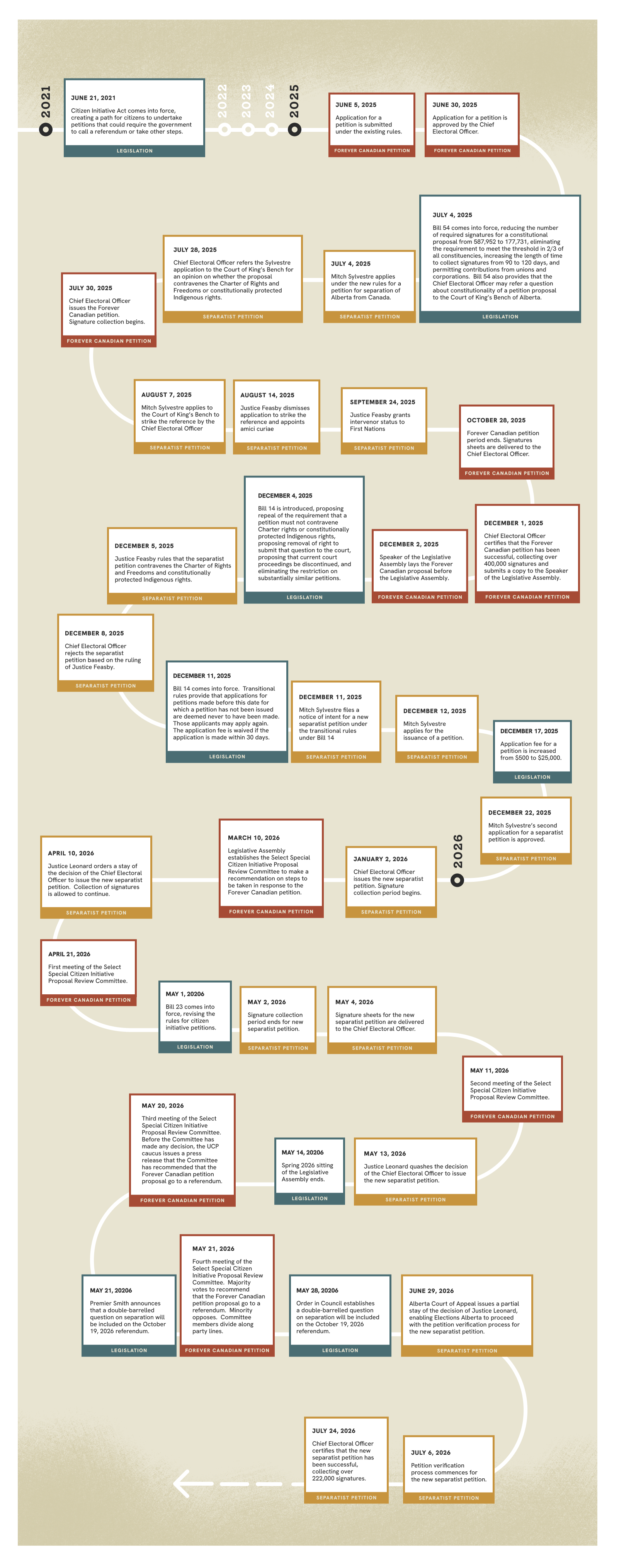
If the LEAVE Canada petition is successful, is the Alberta government required to call a referendum on separation?
Summary
The legislation is unclear on this issue. However, even if it is required to call a referendum, there is no longer an outside date by which it must be called.
Analysis
As a starting point, the LEAVE Canada petition is categorized as “constitutional”, because Alberta’s leaving Canada contemplates a change to the constitution. The response required by the Alberta government to a successful constitutional petition is different from the response required to a policy petition, like that brought by Thomas Lukaszuk, which does not contemplate a change to the constitution.
If a constitutional petition is successful, Section 12(1)(b) of the Citizen Initiative Act requires that the Chief Electoral Officer must submit that proposal to the Minister of Justice. Under Section 16(1), the Minister is then required to refer the proposal to the Lieutenant Governor in Council (effectively, the Cabinet) “for the purpose of a constitutional referendum in accordance with the Referendum Act”. Except as provided in Section 16 of the Citizen Initiative Act, the Referendum Act applies to that referendum.
Section 1 of the Referendum Act says that the Lieutenant Governor in Council may order that a referendum be held on any question relating to a possible change to the constitution.
That leads to the question whether the requirement under the Citizen Initiative Act to refer the proposal to the Lieutenant Governor in Council “for the purpose of a referendum” means that the Lieutenant Governor in Council is required to order that a referendum be held or whether, after it receives the referral of the proposal, the Lieutenant Governor in Council retains the discretion under the Referendum Act to order or not to order a referendum.
Until recently, the answer to this question was clear. Section 16(3) and (4) of the Citizen Initiative Act went on to specify a date by which the referendum must be held. As the Act required that the referendum be held by that date, it was clear that the Lieutenant Governor in Council was required to order that the referendum be held. However, this requirement was repealed by Bill 26, effective May 1, 2026, giving rise to the current ambiguity.
Even if the Lieutenant Governor in Council is still required to order a referendum following a successful constitutional referendum, an outside date for that referendum is no longer specified. The absence of a specified outside date may operate in practice, at least for the immediate future, as a discretion on the part of the Lieutenant Governor in Council not to call the referendum at all.
Background Information
Citizen Initiative Act
Section 12(1)(b)
If the Chief Electoral Officer determines under section 10 that the requirements of section 6 have been met and that the prescribed reports under Part 3 are complete with respect to an initiative petition, the Chief Electoral Officer shall … in the case of a constitutional referendum proposal, submit a copy of the proposal to the Minister, ….
Section 16 (1)
On receiving a copy of a constitutional referendum proposal from the Chief Electoral Officer, the Minister shall refer the constitutional referendum proposal to the Lieutenant Governor in Council for the purpose of a constitutional referendum in accordance with the Referendum Act.
Section 16(3) Repealed effective May 1, 2026
Subject to subsection (4), a referendum must be held on or before the date fixed for the next general election under section 38.1 of the Election Act.
Section 16(4) Repealed effective May 1, 2026
If the date fixed for the next general election under section 38.1 of the Election Act is less than one year after the date on which the Minister received a copy of the constitutional referendum proposal under section 12(1)(b), the referendum must be held before the general election following the general election referred to in subsection (3).
Referendum Act
Section 1
The Lieutenant Governor in Council may order that a referendum be held on any question relating to the Constitution of Canada or relating to or arising out of a possible change to the Constitution of Canada.
Question 10: What do the new referendum separation questions really mean and what happens if Albertans vote for option 1 or option 2?
Summary
The referendum question on separation sets out two options – one for Alberta to remain a province of Canada and one for the Alberta government to start the legal process required to hold a further, binding referendum on separation.
The option to remain a province of Canada is clear.
The option to commence a process required to hold a further referendum likely refers to the requirement that the Alberta government must undertake consultations with Indigenous persons before holding a referendum on separation.
If Alberta is successful in its appeal currently before the Alberta Court of Appeal, this second option will be meaningless because the government argues there is no legal requirement to undertake consultations with Indigenous persons before holding a referendum on separation. Further, if the Alberta government is successful in its appeal, it will be required to hold a second referendum proposing separation, even if the vote on the first referendum this October rejects separation.
The Alberta government is not bound to respect the decision of the voters on the first referendum. If a second referendum is held on the separation petition, the government will not be required to respect the decision of the voters on that referendum either, because the court has found that separation contravenes the Charter of Rights and Freedoms and constitutionally protected Indigenous rights.
Analysis
Typically, a referendum question is structured to require either a “yes” or a “no” answer. That is true of the first 9 questions that the Alberta government has set for the vote on October 19. However, the 10th question – the one relating to separation – has been structured not as a “yes” or “no” question, but rather as a choice between two options. Elections Alberta has set out the choice as follows:
Option 1: Alberta should remain a province of Canada.
Option 2: The Government of Alberta should commence the legal process required under the Canadian Constitution to hold a binding provincial referendum on whether or not Alberta should separate from Canada.
This unusual structure reflects a choice made by the Alberta government in the face of competing petitions under the Citizen Initiative Act about whether Alberta should stay in Canada or leave Canada.
The Stay Petition
The first petition was proposed by Thomas Lukaszuk in June 2025, asking the question:
Do you agree Alberta should remain in Canada?
On December 1, 2025, the Chief Electoral Officer certified that this petition had been successful, having secured in excess of 400,000 signatures. (See our article What Happened to the Forever Canadian Petition? for more about the process.) Ultimately, a committee of the legislature recommended to the full legislature that this question be put to the people of Alberta by way of a referendum. Rather than waiting for the legislature to consider this recommendation, the government decided to act on its own and introduce a referendum question with an option for Albertans to vote to remain a province of Canada. The wording of this option is slightly different from that of the Lukaszuk question but to the same end.
The meaning of this option is clear.
The Leave Petitions
The second petition was proposed by Mitch Sylvestre in July 2025, asking the question:
Do you agree that the Province of Alberta shall become a sovereign country and cease to be a province in Canada?
On December 5, 2025, Justice Feasby of the Alberta Court of King’s Bench ruled that this petition contravened the Charter of Rights and Freedoms and constitutionally protected Indigenous rights. Three days later, the Chief Electoral Officer rejected this petition, based on the existing language of the Citizen Initiative Act and this decision of the court.
Later that month, the Citizen Initiative Act was amended to remove the requirement that a petition must not contravene the Constitution. Mitch Sylvestre then proposed a further petition, asking the question:
Do you agree that the Province of Alberta should cease to be a part of Canada to become an independent state?
The Chief Electoral Officer approved this second petition. On May 4, 2026, Sylvestre delivered the signature sheets to the Chief Electoral Officer, claiming that he had secured over 300,000 signatures in favour of this petition. However, nine days later, Justice Leonard of the Alberta Court of King’s Bench quashed the decision of the Chief Electoral Officer to approve this petition, finding that:
as Sylvestre’s first petition had been rejected by the Chief Electoral Officer, it could not be resubmitted as a second petition;
the Alberta government had a duty to consult with Indigenous persons before the Chief Electoral Officer could approve this petition; and
the proposal in this petition would contravene the Charter of Rights and Freedoms and constitutionally protected Indigenous rights, as earlier found by Justice Feasby.
This decision put an end to the second Sylvestre petition, at least for the time being.
Both Sylvestre and the government of Alberta have appealed this decision. The Alberta Court of Appeal ruled that the Chief Electoral Officer could undertake the verification process on the signature sheets that had been delivered, pending the results of the appeal. On July 24, 2026, the Chief Electoral Officer advised that it had verified 222,597 signatures, in excess than the 177,732 signatures required for a successful petition. However, the decision of Justice Leonard striking this petition remains in place unless and until it is ultimately overturned by the Court of Appeal.
Rather than waiting for the decision of the Court of Appeal on the merits of the appeal, the Alberta government decided to act on its own and include on the October 19 ballot an option to commence the process for a referendum leading to separation. As Justice Leonard determined that the government is required to undertake consultations with Indigenous persons before setting a referendum question proposing separation and as the Alberta government has not undertaken those consultations, it posed the option that:
The Government of Alberta should commence the legal process required under the Canadian Constitution to hold a binding provincial referendum on whether or not Alberta should separate from Canada.
Unlike Option 1, the meaning of Option 2 is not clear.
What does Option 2 mean?
There are at least two questions here.
First, what is the legal process required under the Canadian Constitution to hold a binding provincial referendum on separation?
The Canadian Constitution does not expressly set out a legal process required for a province to hold a binding referendum on separation. In 1998, the Supreme Court of Canada issued a decision in the case of Reference re Secession of Quebec on the trigger for constitutional negotiations in the event a referendum on a clear question achieves a clear majority in favour of separation. Following that decision, the federal government passed the Clarity Act, setting out the process for the federal government to determine whether a referendum question is clear. However, other than the decision of Justice Leonard respecting the Sylvestre petition, there is little or no case law on the legal process required by the Canadian Constitution to be undertaken by a province before a referendum is held on separation. And while the decision of Justice Leonard specifies a requirement to undertake consultation with Indigenous persons, it does not specify the nature or extent of consultations required or the result if those consultations are unsuccessful.
Here is where things get tricky.
In its argument before Justice Leonard, the Alberta government argued that the duty to consult is not triggered until after the referendum. The government is repeating that argument in its appeal of Justice Leonard’s decision. If the government is right, then there is no “legal process required under the Canadian Constitution to hold a binding provincial referendum on separation”. In other words, the government has posed a referendum option to undertake a required legal process that the same government argues does not exist.
Further, the Chief Electoral Officer has determined that the second Sylvestre petition received the required number of signatures to trigger a referendum. If the Alberta government successfully appeals the decision of Justice Leonard, it will be required to hold a referendum on the separation question set out in the second Sylvestre petition, as provided in Section 16(1) of the Citizen Initiative Act. The Minister of Justice will have some limited discretion to recommend changes to that question to ensure that it will result in a clear expression of the will of electors and is “otherwise suitable to be put to the electors”. However, if the Alberta government succeeds in its appeal in setting aside the decision of Justice Leonard, Albertans will be faced with another referendum on separation. And this further referendum will be required, even if Albertans on October 19 the majority of Albertans select Option 1 to remain in Canada.
Second, Option 2 refers to a “binding” provincial referendum. What does that mean?
It is important to understand that when the Alberta government added these options to the October 19 referendum, it specified it will not be bound by the decision of the voters. If more votes are cast for Option 2 (commence the process leading to binding referendum on separation) than Option 1 (stay in Canada), the government could still decide not to commence the process of consultation with Indigenous persons required to hold a referendum. If more votes are cast for Option 1 than Option 2, the government could still take steps towards separation.
Under the rules established by the Alberta government when it set the referendum question, it will be bound only if:
Option 2 prevails over Option 1
the government then chooses to commence the process of consultation and completes that process
the government then chooses to hold a referendum on separation, and
that referendum is successful.
Even then, the Alberta government may not be bound to do anything.
Section 4(2) of the Referendum Act says that if the results of a referendum are binding, the government must take any steps within its competence that it considers necessary or advisable to implement the results of the referendum. However, that is qualified by Section 4(3) of the Referendum Act which states that the government is not required to implement the results of the referendum if doing so would contravene the Charter of Rights and Freedoms or constitutionally protected Indigenous rights. That is further qualified by Section 8.11(3) of the Referendum Act which states that nothing in a referendum is to be construed as abrogating or derogating from constitutionally protected Indigenous rights. And Justice Feasby has already determined that separation would contravene both the Charter and constitutionally protected Indigenous rights. That means that in this case, the Alberta government would not be bound by a binding referendum.
Further, even if the Alberta government were to take steps to implement a successful referendum vote in favour of separation, Alberta does not have the right on its own to separate from Canada. Separation can only occur following negotiations with the governments of Canada and the other provinces. Engaging in a process of negotiation around separation does not necessarily mean that separation will occur or, if it occurs, that it will occur under any specific terms.
So where does this leave us?
In setting these options for the October 19 referendum, the Alberta government has jumped the gun.
With respect to Option 1 (stay in Canada), the Alberta government didn’t wait for the legislature to determine how to deal with the successful petition brought by Thomas Lukaszuk, as the Citizen Initiative Act contemplates. Rather, it decided on its own to bring forward a referendum question proposing that Alberta stay within Canada. That question, at least, is clear.
With respect to Option 2 (commence the process for a referendum to leave Canada), the Alberta government didn’t wait for the results of the appeal of the decision of Justice Leonard. Option 2 proposes that the government undertake a required legal process while arguing before the Alberta Court of Appeal that there is no such required legal process. If the Alberta government prevails on its appeal of Justice Leonard’s decision, Option 2 will be meaningless. Further, if it prevails on its appeal, the government will be required to hold a second referendum on separation, even if the Alberta electors were to choose Option 1 over Option 2. And after all of that, even if that second referendum were to be successful, the Alberta government is not bound to pursue separation because separation has been held to contravene both the Charter of Rights and Freedoms and constitutionally protected Indigenous rights.
Confused? So are we.
Our View
We are voting for the clear option to remain in Canada.
What message are you sending?
On October 19, Albertans will be asked to vote on ten referendum questions, all of them important to Alberta’s future but none more important than whether to start the process for separating from Canada.
In conversations with Albertans, we hear some people say, “I don’t want to separate from Canada but I want to send a message to the federal government.” They talk about longstanding grievances with Ottawa and the illusive Laurentian elite who are thought to hold power in eastern Canada, ignore Alberta’s needs and fail to respect the contributions Alberta – and especially Alberta’s resources – provide to the rest of Canada. These grievances date back decades but have escalated during the Trudeau era.
Ask these same people about the specifics of the grievances and they provide varying answers or no answers at all – they’re just angry. Some talk about the unfairness of equalization. Others complain about unfair taxes stifling growth of resource development or environmental laws preventing shipping on the west coast, the “no more pipelines” law. Often, they ignore the fact that the federal government, did, in fact, pay for a pipeline to the west coast. For still others, it’s just the mention of the word “Trudeau” that spurs their anger.
In the face of the pending referendum on whether Alberta pursues the next steps towards separation, there are other groups of Albertans saying things have changed. That it’s time for Alberta to “lead not leave”. With a new Prime Minister – a Prime Minister from Alberta for the first time since Stephen Harper – there are clear signs that the attitude to Alberta, and especially developing Alberta’s resources, has changed significantly. Alberta now is pursuing not only one pipeline to the west coast but potentially another going east to Sarnia, Ontario. Instead of being an obstacle, the federal government is a willing partner and signs point to potentially getting the greenlight on a new pipeline to the west coast before Alberta votes on October 19.
Those developments, and a general sense of growing optimism about Canada and Canada’s future not only at home but around the world, beg the question: When people vote on October 19, what message are they sending? What specifically would they like to see change to convince them that Ottawa is listening?
The vote on October 19 is more than simply sending a message. It’s an unprecedented signal to the rest of Canada that we’re either proud Canadians, willing to step up and lead the country in making Canada and our province a better place. Or we’re prepared to launch the next step in a long process that would let Albertans vote on separating from Canada.
Make no mistake, this vote has direct and serious consequences. If the majority of Albertans choose Option B, it directs Alberta’s government to commence the process to hold a binding referendum on whether or not Alberta should separate from Canada. Choosing Option B doesn’t just send a message. It’s not some idle bluff. We don’t get to walk away after, pat ourselves on our backs and say, now they’ll listen to us.
As Jared Wesley and Patricia Paradis outline in their recent article, The many hazards of Alberta’s Option B:
“Option B is not a harmless way to ‘keep the door open’ to independence, or to ‘send Ottawa a message’. Rather, it is a vote to put the province into constitutional limbo: years of Crown-Indigenous conflict, consultations, court cases, campaigns, and internal party warfare over a departure whose terms cannot be known in advance. Worse yet, Alberta would spend years trying to renegotiate the benefits it already enjoys – access to a national market, shared public programs, national defense, mobility rights, and international reputation – with no guarantee of retaining them and every possibility of paying more for less.”
Voting for Option B sends a signal to the rest of Canada and the world that Alberta is serious about separation and will move forward, even though the process to hold a vote on a binding referendum will do untold damage to our province. It will involve not months but years of distracting debates. It will cripple the province’s ability to move forward on important issues that will actually make a difference for Albertans’ day to day lives and marginalize Alberta at a time when we have genuine opportunities to lead, to strengthen our province and our country.
For supporters of new pipelines, does anyone honestly believe the federal government would move ahead with a major commitment to a pipeline in the face of a potential vote to leave Canada? Are any private sector proponents likely to come forward in the face of that uncertainty? Does anyone think the threat of separation hanging over our heads for years will make things better? And what damage will the ongoing uncertainty cause for Alberta’s economy? We already have signals from Alberta’s business community that the referendum on October 19 is putting a damper on investment and many businesses are openly saying they will leave the province if we pursue separation.
We’ve seen the damage referendums in Quebec have caused and the lessons from Brexit are obvious today. While Albertans engage in a costly and non-productive debate over separation, business opportunities will dry up, investment will flee, entrepreneurs and professionals will leave. We’ve seen those warnings from Quebec and Britain and in spite of the fanciful and unrealistic claims from the true separatists, there’s no reason to believe it would be different in Alberta.
While many are focussed on sending a message to Ottawa, how people vote on October 19 also sends a message to the provincial government. It says to the province, we want you to set aside the issues that matter most to us – affordability, access to health care, improving education for our kids – and continue debating separation, pitting Albertans against each other and putting other important issues on hold while this becomes the single issue consuming the provincial government’s attention. It may appease some members of the UCP government and its supporters, but is this really what the majority of Albertans want their government to be focused on over the next few years? Especially at a time when the rest of Canada is talking about working together to grow our economy. A time when there’s real optimism that Canada, finally, is stepping up and reducing our reliance on a single trading partner. A time when Alberta has real opportunities to lead and build an economy with jobs and opportunities for future generations of young Albertans.
Finally, voting for Option B also sends a message to President Trump, who continues his threats of Canada becoming the 51st state. While our Prime Minister and Premiers across the country are actively countering the 51st state threats, a vote by for Option B by Albertans opens the door. It sends a message not only to Ottawa but to the U.S. and the message to them is “maybe.” Maybe there’s a route to Alberta becoming the 51st state after all, and with our rich natural resources and clear route to the Arctic, maybe that’s all the U.S would really want.
Make no mistake, October 19 is a critically important day for Alberta. How Albertans vote on separation will send a message to the rest of Canada, to businesses and potential investors in Alberta, to our federal government, to our own provincial government, and to countries watching around the world. Albertans should think seriously about the message they are sending and the repercussions it will have for Alberta’s future.
Our View
We are voting for option A, the clear option to remain in Canada.
What did Justice Leonard Decide?
Summary
In an application brought by a group of First Nations, Justice Leonard quashed the decision of the Chief Electoral Officer which had approved a petition for separation of Alberta from Canada.
The primary ground for her decision related to timing: the application had already been rejected under the existing legislation and could not be revived under the amended legislation, which was designed to remove obstacles in the way of the separatist petition.
Justice Leonard also found that the government failed to exercise its duty to consult with Indigenous peoples before approving this petition and that the proposal in the petition was unconstitutional.
These latter findings blocked the government from placing a direct question favouring separation on the October 19 referendum ballot and resulted in the double-barreled question eventually adopted by the government.
Background
On December 5, 2025, Justice Feasby ruled that the separatist proposal in the first Mitch Sylvestre petition contravened rights under the Charter of Rights and Freedoms and constitutionally protected Indigenous rights. (See our post: What did Justice Feasby Decide?)
In light of that decision, the Chief Electoral Officer rejected the petition. Several days later, Bill 14 came into force, removing the prohibition in the Citizen Initiative Act against petitions that contravene constitutional rights. The following day, Mitch Sylvestre applied again for approval for a petition, this time with the question: “Do you agree that the Province of Alberta should cease to be part of Canada to become an independent state?”
On December 22, 2025, the Chief Electoral Officer approved this petition. That decision was challenged in court by the Athabasca Chipewyan First Nation, the Piikani Nation, Siksika Nation and Blood Tribe. The matter was heard by Justice Leonard of the Court of King’s Bench of Alberta.
On April 10, 2026, Justice Leonard granted a stay of the decision of the Chief Electoral Officer, pending her decision on the merits. The signature gathering process continued, but validation and counting of signatures was put on hold. On May 13, 2026, Justice Leonard issued her decision on the merits and quashed the decision of the Chief Electoral Officer, effectively setting aside the petition.
This decision has received a lot of publicity relating to the duty of the government to consult with Indigenous peoples before embarking on conduct that may impact their treaty rights. (See our post: What does “Duty to Consult” Indigenous peoples mean for the separatist campaign?) However, that was not the primary basis on which the case was decided. The primary basis related to timing.
The Chief Electoral Officer rejected Sylvestre’s initial petition on December 8, 2025. Bill 14 came into force on December 11, 2025. It included certain provisions relating to the transition from the legislation as it had been and the legislation as amended. They provided that:
An application for the issuance of an initiative petition made before [December 11, 2025] for which an initiative petition has not been issued under section 3(3)(a) as of [December 11, 2025] is deemed never to have been made.
Section 3(3)(a) requires the Chief Electoral Officer to issue a petition when the statutory requirements for that petition have been met.
The transitional provisions went on to say:
If an application is deemed never to have been made under subsection (1), the applicant may submit a notice of intent with the same subject-matter as the application deemed never to have been made, and if the applicant does so within 30 days of the coming into force of this section, the application fee required under section 2(2)(h) is waived in respect of the new application submitted in respect of the notice of intent.
The waiver of the fee was important. On December 17, 2025, the government increased the fee from $500 to $25,000, raising a financial barrier against later petition applications.
The transitional provisions were advantageous to the separatist petitioners and Sylvestre followed the route set out in those provisions. The day after Bill 14 came into force, he applied for a new petition, with slightly different wording from his initial petition. The application fee was waived, the Chief Electoral Officer approved the petition on December 22, 2025, and the petition was issued on January 2, 2026.
The Province of Alberta, opposing the application of the First Nations to quash the approval of the petition, argued that the initial Sylvestre application had been made before December 11, 2025, and a petition had not been issued before December 11, 2025, therefore it was deemed never to have been made. Under the transitional provisions, Sylvestre was at liberty to submit a new application without being required to pay a new fee.
To be sure, the first Sylvestre application was made before December 11, 2025, but was it an application for which a petition had not been issued by that date? Justice Leonard found that it was not. She read this provision to apply to applications for petitions that were pending as of December 11, 2025, not applications that had already been rejected by that date. “Simply put, the First Proposal was not pending when the amendments came into force. It had been rejected and had come to an end.” She went on to find “it follows that because the First Proposal was rejected, it cannot be resubmitted.”
Justice Leonard found there was a further ground for overturning the decision of the Chief Electoral Officer to approve the second application. She held that the Crown (in this case the Alberta government) had a duty to consult with Indigenous persons before approving an application for a petition for Alberta to leave Canada and form an independent country because such a petition would set in place a process that could impair treaty rights, protected by s. 35 of the Constitution Act.
Justice Leonard also found a third ground for overturning the decision on the basis that the Chief Electoral Officer is required to act in accordance with the Constitution. At the time the second petition was approved, the Chief Electoral Officer was aware of the finding by Justice Feasby that the proposal in the petition would contravene both Charter and constitutionally protected Indigenous rights. His decision to approve the second petition was therefore unreasonable.
While the government of Alberta has an independent power to call a referendum on constitutional issues, these additional grounds in the decision of Justice Leonard presumably apply not only to the Chief Electoral Officer but also to the government, which is bound to comply with the Constitution. These findings effectively blocked the government from adding a question directly proposing separation on the October 19 referendum ballot. This led to the double-barreled question that has been placed on the ballot, which includes the commencement of consultation with Indigenous persons as a prequel to a later referendum on separation.
What did Justice Feasby decide?
Summary
The case of Chief Electoral Officer of Alberta v. Mitch Sylvestre and Minister of Justice of Alberta involved a reference to the court on whether Mitch Sylvestre’s application for a petition on Alberta separation contravened rights under the Charter of Rights and Freedoms and constitutionally protected Indigenous rights.
Justice Feasby determined that the proposed petition would contravene both. Three days after that ruling, the Chief Electoral Officer rejected this petition application.
However, this was only the first stage of litigation respecting the separatists’ petitions. The litigation continued in the case of Athabasca Chipewyan First Nation v. Chief Electoral Officer and His Majesty the King in Right of Alberta.
Background
On July 4, 2025, immediately after new provincial rules came into effect to make it easier to have a successful citizens’ petition, Mitch Sylvestre applied to Alberta’s Chief Electoral Officer under the Citizen Initiative Act for approval of a petition asking: Do you agree that Alberta shall become a sovereign country and cease to be a province in Canada?
At that time, the Citizen Initiative Act provided that:
An initiative petition proposal must not contravene sections 1 to 35.1 of the Constitution Act, 1982.
Sections 1 to 34 of the Constitution Act, 1982 comprise the Charter of Rights and Freedoms. Sections 34 and 34.1 provide that existing aboriginal and treaty rights of the aboriginal peoples of Canada are recognized and affirmed. (The Constitution uses the term “aboriginal” rather than “Indigenous”.)
The question therefore arose whether the proposal for Alberta to separate and become a sovereign country contravened Charter rights or constitutionally protected Indigenous rights. The new rules under the Citizen Initiative Act provided a mechanism for answering this question. They stated that the Chief Electoral Officer was empowered to refer to the Court of King’s Bench of Alberta the issue of whether the proposal in a petition application contravened constitutionally protected rights. On July 28, 2025, the Chief Electoral Officer exercised this power and referred this question to the court. Justice Feasby was appointed to hear the case.
As a first step in this process, the proponent sought an order to strike the reference, calling it an abuse of process and an affront to democracy. Justice Feasby dismissed this application.
As the Alberta government supported the proponent’s argument that the petition was not unconstitutional and as the Chief Electoral Officer took no position on the issue, Justice Feasby appointed independent counsel, known as amici curiae, to present the opposing argument and to present their own independent conclusion on the question.
He also established a process for people to apply as intervenors in the case, which would give them status to present arguments. Pursuant to that process, he later granted intervenor status to the Confederation of Treaty 6 First Nations, Treaty 8 First Nations of Alberta, Athabasca Chipewyan First Nation, Samson First Nation, Sturgeon Lake Cree First Nation, and Mikisew Cree First Nation.
The case continued with submissions being made over the fall of 2025.
On December 4, 2025, the Alberta government introduced Bill 14. Among other things, the bill provided for the repeal of the requirement that petition proposals must not contravene constitutionally protected rights. It also provided for the repeal of the right of the Chief Electoral Officer to refer this question to the court and said any referral of the question of constitutionality already before the court was to be discontinued.
The next day, Justice Feasby issued his decision. He noted that although Bill 14 proposed the discontinuance of these proceedings, it had not yet been passed or proclaimed into law and therefore the case remained alive. He found that “changing legislation to circumvent a valid legal process commenced by the independent officer of the Legislative Assembly responsible for administering democratic processes is the antithesis of the stable, predictable, and ordered society that the rule of law contemplates, and democracy demands.” He concluded that attempting to end this litigation was contrary to the rule of law and disrespected the administration of justice.
On the merits of the case, Justice Feasby found that the proposal in the petition contravened the Charter because separation would require the replacement of the Canadian constitution without any guarantee that existing Charter rights would be replaced in an Alberta constitution. He found that Alberta independence would contravene the Charter-guaranteed right to vote, mobility rights, and minority language rights.
Justice Feasby also found that the petition’s proposal contravened constitutionally protected aboriginal and treaty rights in two ways. Firstly, because independence would involve removing Canada and substituting an independent Alberta as the entity responsible for fulfilling treaty rights. And secondly because independence would transform provincial and territorial boundaries into international borders, impairing treaty rights to move freely through the lands for the purpose of hunting and fishing.
Following receipt of this judgment, the Chief Electoral Officer rejected the Sylvestre petition on December 8, 2025.
On December 11, 2025, Bill 14 came into force. The following day, Mitch Sylvestre applied for approval of a petition on a substantially similar question, purportedly under the new rules established by Bill 14. The Chief Electoral Officer approved that petition which then became subject to another court challenge heard by Justice Leonard. (See our post: What did Justice Leonard decide?)
The Petition for Separation and Indigenous Rights
Summary
The Crown is a party to a series of treaties with Indigenous peoples signed before Alberta was created as a province. The boundaries of individual treaties extend beyond what were later to become provincial and territorial boundaries.
Treaty rights are affirmed in s. 35 of the Canadian Constitution.
The Crown has a duty to consult with Indigenous peoples when it is aware of Indigenous rights and contemplates acting in a way that might adversely affect those rights. At a minimum, the consultation must be in good faith and with the intention of substantially addressing the concerns of Indigenous peoples whose lands are at issue.
The legislation in place when the application was made for the first separatist petition required that a petition proposal must not contravene Charter or constitutionally protected Indigenous rights.
On December 5, 2025, Justice Feasby ruled that the separatist proposal contravened both Charter rights and constitutionally protected treaty rights.
The legislation was amended to delete the requirement that a petition proposal must not contravene Charter or constitutionally protected treaty rights. A second application for a separatist proposal was approved by the Chief Electoral Officer.
On May 14, 2026, Justice Leonard ruled that the Crown had a duty to consult with Indigenous peoples before the Chief Electoral Officer approved an application for a petition. She quashed the approval of the separatist petition. That decision is now under appeal.
Background
In the late 1800s and early 1900s, the Crown as represented by the Government of Canada entered into a series of treaties with Indigenous peoples in Western Canada covering all the land in what later was to become Alberta and Saskatchewan, land that later became part of Manitoba, and land forming parts of British Columbia and the Northwest Territories. The boundaries of the lands covered by individual treaties extended across what were later to become provincial and territorial boundaries.
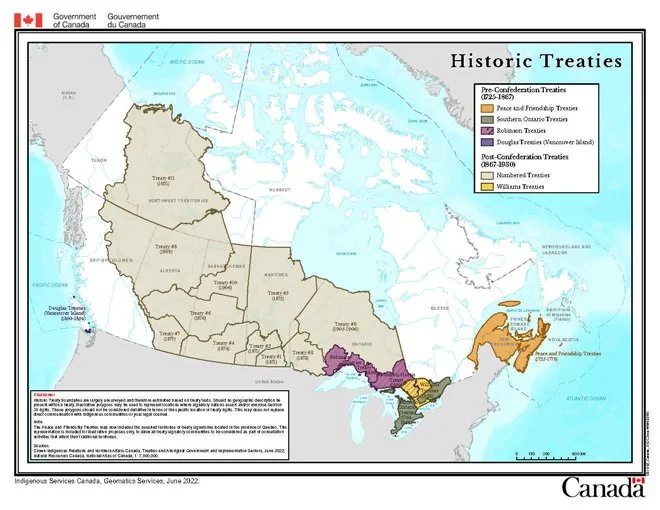
A map of Historic Indigenous Treaties in Canada.
Under each treaty, Indigenous peoples surrendered to Canada all of their rights, titles, and privileges to the land covered by the treaty. In exchange, the Crown made a number of promises, including the creation of reserves for the benefit of Indigenous peoples, the obligation to maintain schools on those reserves, and the recognition of the right of Indigenous peoples to pursue hunting and fishing throughout the lands they had surrendered.
In 1982, the Canadian Constitution was amended to create the Charter of Rights and Freedoms and to recognize the rights of Indigenous peoples under these treaties. Section 35(1) of the Constitution Act, 1982 provides:
The existing aboriginal and treaty rights of the aboriginal peoples of Canada are hereby recognized and affirmed.
This process was described by the Supreme Court of Canada in its 2004 decision in Haida Nation v. British Columbia in the following terms:
Put simply, Canada’s Aboriginal peoples were here when Europeans came, and were never conquered. Many bands reconciled their claims with the sovereignty of the Crown through negotiated treaties. … The potential rights embedded in these claims are protected by s. 35 of the Constitution Act, 1982. The honour of the Crown requires that these rights be determined, recognized and respected. This, in turn, requires the Crown, acting honourably, to participate in the processes of negotiation. While this process continues, the honour of the Crown may require it to consult and, where indicated, accommodate Aboriginal interests.
The Supreme Court of Canada has determined that the duty to consult arises when the Crown has knowledge, real or constructive, of the potential existence of the Indigenous right or title and contemplates conduct that might adversely affect it. The nature and scope of the duty of consultation varies with the circumstances but at a minimum the consultation must be in good faith and with the intention of substantially addressing the concerns of Indigenous peoples whose lands are at issue.
Analysis
When Mitch Sylvestre applied for a petition for separation of Alberta from Canada in July 2025, the Citizen Initiative Act prohibited a petition if the effect of the proposal would contravene either the Charter or rights protected under s. 35 of the Constitution Act, 1982. Under amendments to the Citizen Initiative Act that came into effect days before Mitch Sylvestre applied for his petition, the Chief Electoral Officer was empowered to ask the opinion of the Court of King’s Bench on whether a policy proposal contravened either the Charter or s. 35 of the Constitution Act, 1982.
Within days after the Sylvestre application was filed, the Chief Electoral Officer applied to the Court for an opinion on whether the proposal in that application contravened the Charter or s. 35. Submissions were made on this issue to the Court by Sylvestre, the Province of Alberta, and several First Nations.
On December 4, 2025, the Alberta government introduced Bill 14. Included within the provisions of that Bill, the prohibition on petitions that contravened rights under the Charter or s. 35 was to be eliminated, as was the power of the Chief Electoral Officer to ask the opinion of the Court of King’s Bench about compliance. Existing litigation on this issue was to be discontinued. Instead, the Alberta government was to be relieved of its obligation to implement a proposal for separation following a successful petition and a successful referendum if the proposal would contravene the Charter or s. 35. Instead of having the Chief Electoral Officer and the court deal with the issue upfront, the government would wait out the time, expense, and political and economic consequences of a successful petition and a successful referendum on separation before deciding whether or not to pursue separation because it conflicts with constitutional rights.
The following day, before Bill 14 was passed into law, Justice Feasby issued his opinion. (See our post: What did Justice Feasby decide?) He found that:
Alberta independence would contravene the treaties covering Alberta both as a matter of law and as a practical matter by removing Canada and substituting an independent Alberta as the entity responsible for fulfilling treaty obligations.
Alberta independence would transform provincial and territorial boundaries falling within the lands of specific treaties into international borders. That would contravene the treaties by significantly impairing the exercise of treaty rights by First Nations, such as the right to move freely within treaty lands for the purpose of hunting and fishing.
Justice Feasby also found that Alberta independence would contravene Charter rights because independence would require the replacement of the Canadian constitution without an assurance that Charter rights would be guaranteed in a new Alberta constitution. He also found that Alberta independence would contravene the Charter-guaranteed right to vote, mobility rights, and minority language rights.
As the proposal set forth in the petition contravened both Charter rights and constitutionally protected treaty rights, the petition was prohibited by the terms of the Citizen Initiative Act then in place.
Justice Feasby also found that the attempt by the Alberta government to prevent him from rendering his decision by discontinuing the case before him, contravened the rule of law and disrespected the administration of justice.
This decision was issued on December 5, 2025. Three days later, the Chief Electoral Officer rejected the first Sylvestre application for a petition on the basis that it was prohibited by the terms of the Citizen Initiative Act then in place because it contravened Charter rights and treaty rights recognized under s. 35 of the Constitution. Another three days later, Bill 14 came into force. The following day, Mitch Sylvestre applied again for a petition on separation under the amended legislation that no longer expressly prohibited petitions that would breach Charter rights or constitutionally protected treaty rights. Eleven days later, the Chief Electoral Officer approved this application and on January 2, 2026, he issued the petition.
An application was then brought by the Athabasca Chipewyan First Nation, Piikani First Nation, Siksika Nation, and Blood Tribe to quash the decision of the Chief Electoral Officer to issue this petition. On April 10, 2026, Justice Leonard granted a stay of the Chief Electoral Officer’s decision to issue the petition, pending release of her ruling on the merits. On May 13, 2026, she issued that ruling, quashing the decision of the Chief Electoral Officer to issue the petition.
The primary ground for Justice Leonard’s decision wasn’t related to treaty rights. Rather, it was based on an interpretation of the transitional provisions of Bill 14 and her finding that as Mitch Sylvestre’s first application for a petition had already been rejected by the Chief Electoral Officer, he couldn’t apply again for a petition on substantially the same terms.
Justice Leonard found as an additional ground that the Crown (in this case the government of Alberta) had a duty to consult with Indigenous peoples before putting in place a process that could lead to Alberta’s independence.
Justice Leonard applied the test in the Haida Nation case of the Crown’s real or constructive knowledge of an Indigenous or treaty right, contemplated Crown conduct, and potential adverse effects on the right arising from the Crown conduct. She found that Alberta was aware of the treaty rights and the potential impact a petition on separation, approved by an officer of the legislature, on those treaty rights, as determined by Justice Feasby. In these circumstances, she found that the action of the Chief Electoral Officer in approving the petition constituted Crown conduct for the purpose of triggering the duty to consult. Because no consultation occurred, the government of Alberta breached its duty to consult.
Justice Leonard also explained why the harm was not too remote: although the Referendum Act says that a successful result need not be implemented if it would breach s. 35, that safeguard comes too late, because once a referendum on separation succeeds, the matter passes into the political realm and beyond the court’s supervision.
Justice Leonard found as a further additional ground that the decision by the Chief Electoral Officer to issue a petition calling for Alberta independence was unreasonable in the face of the finding by Justice Feasby that such a petition would contravene s. 35 of the Constitution Act, 1982, because the Chief Electoral Officer is bound to exercise authority in a manner that complies with the constitution.
In the result, the route to success of a petition for a referendum on separation of Alberta from Canada was blocked. While both the government of Alberta and the petitioner stated that they intended to appeal Justice Leonard’s decision, there was no realistic chance that this decision could be successfully appealed in time to allow a campaign on separatism in advance of October 19.
The route to a referendum on separation through the Referendum Act was blocked as well. This legislation gives the government broad authority to put questions to a referendum (as it had already done with the other 9 questions scheduled for the October 19 vote.) But if prior consultation by the government with Indigenous peoples was required before the Chief Electoral Officer could approve a petition on separation that might lead to a referendum proposing separation, prior consultation by the government was also required before it could act directly to call a referendum proposing separation under the Referendum Act.
For a description of how the government came to call a double-barrelled referendum question to either stay in Canada or start the process of consultation:
See our post: What happened to the Forever Canadian petition?

Who We Are
Before You Vote was created by a small group of concerned citizens troubled by the lack of credible, fact-based information about the issues facing our province and country. We’ve all worked in or near government, public service, media and laws throughout our careers.